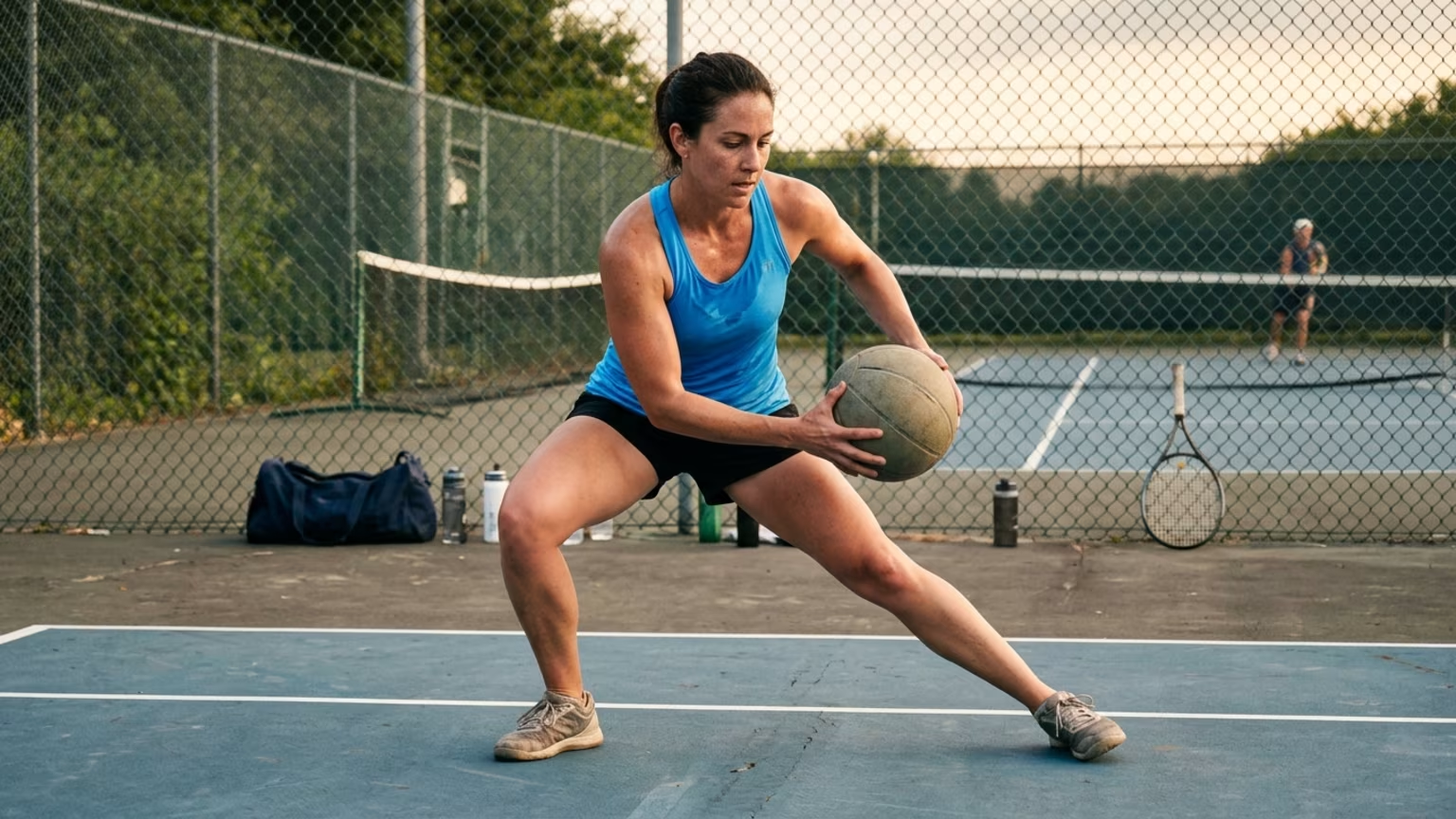

Build a practical, two-day strength plan to support tennis, pickleball, and padel performance. Maintain lower-body resilience without overtraining today.




Mark finishes his second hour of heavy lifting for the week. By Saturday morning, his legs feel like concrete during a crucial third set. The truth is that adult racquet sports players do not need an exhaustive fitness routine to perform well. A minimum-effective-dose approach builds athletic longevity without leaving you too exhausted to play.
Social media fitness algorithms constantly push high-volume lifting and complex agility drills. These trends promise endless energy and perfect joints. The reality for an adult tennis, pickleball, or padel player is vastly different. You are already stressing your joints and muscles heavily during a match.
Adding a professional bodybuilder routine on top of your court time often leads to excessive fatigue. Many online programs suggest that you need complex routines to stay healthy on the court. They promote exhaustive leg days or intense plyometric jumps that leave you sore for days. For a busy adult who just wants to play matches, this approach is entirely counterproductive.
Your primary goal is to enjoy racquet sports for years to come. When you push too hard in the weight room, your performance on the court suffers immediately. Your legs feel heavy, your reaction time slows, and your mechanics start to break down. A smarter approach recognizes that court time already provides a significant athletic stimulus.
Adult racquet athletes need practical strength that directly supports movement on the court. The sport demands rapid acceleration, sudden braking, and repeated changes of direction. You need reliable single-leg control, rotational power, pushing strength and trunk stability. Building these capacities does not require spending hours under heavy barbells.
It requires a focused effort to maintain the physical options necessary to reach, stop, and rotate effectively. Many players find that simple two-day strength workouts provide enough stimulus without causing excessive fatigue. You only need the minimum effective dose of strength work to bridge the gap.
Recent research highlights exactly where racquet players should focus their limited gym time. Lower-extremity injuries are a major factor for recreational participants. In a 2026 study of Korean recreational pickleball players, 38.1 percent reported an injury during the previous year. Lower-extremity injuries made up 44.0 percent of those reported issues.
The knee accounted for 21.4 percent of injuries, and the ankle or foot represented 15.8 percent of the total. This data explains why training the lower body and focusing on balance is so critical. A systematic review and meta-analysis found that neuromuscular training was associated with a lower ankle-injury risk. The same review noted improvements in dynamic neuromuscular control and foot-and-ankle function.
These findings support prioritizing controlled single-leg work and balance over purely lifting heavy weights. Adding dedicated balance training routines can further support your single-leg stability. Similar performance benefits appear in recent tennis research. A 2026 meta-analysis of 18 studies involving 670 male tennis players examined neuromuscular training.
The interventions showed favorable pooled effects for stroke velocity, short sprints, agility time and countermovement jump performance. However, the authors cautioned that certainty was low or very low for most outcomes. They also noted that the evidence did not identify one proven best training method. This uncertainty is exactly why a moderate approach makes sense.
Public health guidance in the UK recommends muscle strengthening on at least two days per week. The same guidance suggests balance activities on two days per week. Two short sessions can easily cover these requirements while leaving plenty of energy for your sport. The key to sustainable strength programs is starting with manageable loads.
Before starting the exact routine, players should understand the specific physical qualities they need. Racquet sports require you to repeatedly load one leg while reaching, changing direction, or braking. The goal is not simply to become stronger in a basic squat. It is to control the pelvis, knee, and foot while producing force on one side.
Rotational power is another critical factor for your serving, forehands, and backhands. Strength work should first establish the ability to resist unwanted rotation before adding high-speed twisting. For adult recreational players, the emphasis should be on crisp, repeatable efforts rather than maximal volume. Rotational work should complement, rather than replace, basic lower-body strength.
Players also need dedicated pushing and pulling strength for shoulder control, posture, and general upper-body balance. A balanced plan should avoid becoming completely focused on the shoulders. Pulling exercises should train the upper back effectively. Pressing movements should be performed through a comfortable range of motion, adjusting carefully if you experience shoulder pain.
Finally, the calf and foot complex helps transmit force during acceleration, deceleration, and split steps. This area is often underprepared when a previously inactive adult suddenly increases court time. Foot-specific work can include short-foot exercises, toe control, and balance reaches. These are capacity-building exercises that support your athletic longevity.
You can build a highly effective strength plan around two sessions of 25 to 35 minutes per week. This structure allows for at least one full recovery day between workouts. The goal is to train movement capacities rather than mimicking isolated tennis or padel strokes. You can progress this framework based on your experience level and current health.
The first session of the week should emphasize single-leg stability and basic pushing or pulling. Begin with four to five minutes of easy cycling or brisk movement to warm up. Add some ankle rocks and bodyweight split squats to prepare your joints.
The second session focuses on hip power, lateral movement, and rotational control. Your warm up can include gentle lateral shuffles and progressively quicker steps. Always consider managing recovery periods when match volume increases.
A simple progression model relies on changing only one variable at a time. Your first goal is always to improve technique and your active range of motion. Once your form is solid, you can add repetitions within the target range. After reaching the top of that range, add a small amount of load.
If your recovery remains good, you can eventually add another set. Finally, you might move to a more demanding unilateral, lateral, or faster variation of the exercise. Players should distinguish normal training effort from actual warning signs. Increasing pain, altered movement, or persistent swelling warrants assessment by a qualified medical professional.
The pickleball injury literature illustrates exactly why weekly training load matters. The 2026 Korean study associated greater weekly playing volume with injury occurrence. While this observational design does not prove that volume alone causes injuries, the link is important. A sensible strength plan must be paired with careful progression in your court time.
Beginners should prioritize consistency and technical control over lifting heavy weights. Start with stable, two-leg exercises and supported single-leg balance near a wall. You can build up from there as your movement quality improves. Intermediate players can gradually increase the load and move toward more unilateral exercises.
Advanced or competitive adult players should use heavier sets for the main strength exercises. You can also introduce low-volume medicine-ball throws or reactive footwork. It is highly important to reduce your lifting volume during heavy competition periods. Avoid placing your most demanding lower-body session immediately before a tournament or league match.
Start replacing exhausting gym sessions with a practical, two-day routine that targets lower-body resilience and court-specific movement capacities today.
Follow Evercourts for practical insights on tennis, pickleball and padel performance, movement, recovery and healthy ageing. Stay connected for new articles, research-led guidance and ideas to help you play well and keep playing for years.


Holger Rune withdrew from the European Open with a back problem. The facts behind his decision and a grounded perspective for recreational players.

The Dink’s October 17 guide emphasizes deep returns, ball-height decisions and positioning against faster pickleball opponents.

A new report outlines padel and tennis gear trends. Learn how to assess adjustable rackets, sensor feedback and smart-court claims.
Read practical guidance for better movement, smarter preparation and a game that keeps working for you.
explore the Blog
