

Learn how adult racquet sports players adapt their habits, training, and formats to sustain a lifetime of tennis, pickleball, and padel participation.




USTA says U.S. tennis participation has risen 54% since 2019. That remarkable surge shows a massive return to the court, but the fitness industry wrongly insists these adults need extreme interventions to survive the sport. The truth is that athletic longevity does not come from complex performance protocols or rigid recovery routines. A lifetime of court time depends simply on practical adaptation, realistic expectations, and treating general strength as a baseline rather than a pursuit of elite performance.
Social media feeds constantly promise that specific programs will stop every ache and preserve ranking-level performance forever. Marketing campaigns suggest that taking the right supplement is the only way to avoid injury as you age. This noise creates a false standard that makes recreational athletes feel inadequate if they cannot match the intensity of a professional. Many players mistakenly believe they must either train like an elite competitor or quit the sport entirely.
The reality for adult racquet sports players is much more grounded. Real players face shifting seasons, changing family demands, unexpected injuries, and natural physical transitions. A sustainable player does not need to maintain the exact same weekly volume or tournament schedule for decades. Sometimes the smartest move is dropping down a division, becoming a doubles specialist, or taking a temporary break from competitive singles.
The industry context strongly favors this type of natural adaptation. Because tennis participation has grown for six consecutive years in the U.S., you will likely find more local leagues and hitting partners than ever before. You do not need to cling to a single competitive group if your schedule changes. A healthy relationship with the sport means recognizing that your participation will naturally ebb and flow alongside the rest of your life.
Instead of chasing the physical capacities of a twenty-year-old, veteran players focus on continuity. You can maintain a lifelong connection to the sport by setting goals that prioritize consistency over peak performance. Managing your load across seasons prevents the sudden spikes in intensity that often precede setbacks. Carefully building a sustainable match schedule ensures you stay healthy enough to play year after year.
The evidence supports moderate and consistent preparation rather than magical solutions. A review of 41 randomized trials found that resistance exercise improved muscle-specific strength in older adults. That foundational strength acts as a protective buffer for your joints during quick direction changes. However, this general benefit does not mean a single specific tennis exercise guarantees perfect health.
Resistance training is simply court-time insurance for your joints. A practical baseline is two short strength sessions per week, adjusted for your personal training age and medical history. You do not need to lift massive weights to see a benefit. The goal is to ensure your legs, hips, trunk, and shoulders have the capacity to handle repetitive swinging and sudden stops.
When looking at injury prevention, targeted physical preparation shows clear benefits. One meta-analysis found that neuromuscular training was associated with a 55% lower incidence of ankle injuries among athletes. That research included 18 studies involving 670 participants and found promising but low-certainty evidence for several tennis-performance outcomes. The science indicates that preparing your body with general strength and mobility work creates a valuable baseline. Following a structured multi-year plan can help you implement these habits gradually.
We must also look at the broader health associations of playing racquet sports. In an observational Copenhagen cohort, tennis participation was associated with an estimated 9.7-year difference in life expectancy compared with sedentary behavior. A 2018 observational study reported lower all-cause and cardiovascular mortality among people who participated in racquet sports. These associations highlight the massive value of staying active, even if they do not prove that the sport directly causes a specific lifespan increase.
Research also highlights the psychological component of staying active after an injury. Current return-to-sport frameworks favor combining strength, functional performance, and psychological readiness. You should not rely strictly on a rigid calendar when deciding to play again. The goal is to build resilience across all areas of your game so you feel confident returning to competition.
You can maintain a lifelong connection to the sport by adopting sensible routines that respect your current physical state. If injuries or access issues arise, simply shift your format instead of quitting completely. The International Padel Federation reports more than 38 million padel players across more than 170 countries. SFIA figures cited in industry reporting estimate that 24.3 million Americans played pickleball in 2025.
These expanding options make it easy to adapt your game as your needs change over time. If a shoulder issue limits your tennis serve, you can temporarily switch to pickleball to stay active. Pickleball participation is not evenly distributed between casual and regular players. One 2026 report estimated 16.8 million casual participants and 7.48 million core players in 2025. This shows that millions of adults are successfully integrating these alternatives into their weekly routines.
The sheer volume of people trying new formats is staggering. For example, an APP study cited by AAA reported that more than 48 million American adults had played pickleball at least once during the previous 12 months in 2023. Taking advantage of this format adaptability keeps you connected to the broader racquet sports community. You can always find a match that fits your current physical capacity.
In our experience, proper preparation is another non-negotiable habit for veteran players. When our team first started playing pickleball, we noticed how many people skipped warming up entirely. They would jump straight out of their cars and right up to the kitchen line. We tried doing that and immediately pulled a calf muscle.
Pickleball requires just as much explosive lateral movement as tennis, just in a tighter space. Since then, we always spend five minutes doing dynamic lunges and ankle rolls. It changes everything about how confident we feel pushing off the baseline. Skipping this crucial step can lead to serious setbacks for older athletes.
A ValuePenguin analysis cited by Missouri Public Radio estimated 125,000 pickleball-related ER visits among adults aged 50 and older between 2018 and 2025. You can easily avoid becoming part of that statistic by prioritizing a structured warm-up routine. Sports-medicine professionals from Baylor College of Medicine recommend allowing approximately 15 minutes for a proper tennis warm-up. Taking that time to prepare your body is far more effective than trying to manage a preventable strain later. A solid foundation helps significantly when building your aerobic base for long weekend tournaments.
Measuring what matters is another vital habit for veteran athletes. You should track your pain response, physical recovery, energy levels, and overall enjoyment rather than obsessing over wins. A player who competes less frequently but remains socially connected and physically capable is succeeding at the long game. This pragmatic mindset helps you avoid the trap of pushing through setbacks just to maintain a ranking.
Public facilities also make adaptation easier for adults who cannot commit to private club memberships. USTA reports that more than 27.3 million people played tennis in the U.S. in 2025, with nearly 40% playing in public parks. The sport is also becoming more diverse, as women’s U.S. tennis participation rose 10% in 2025, while participation among Black/African American players increased 14%, according to USTA-related reporting. This accessible infrastructure allows players of all backgrounds to stay engaged without the pressure of expensive fees or strict schedules.
That massive 54% wave of players rejoining the sport since 2019 does not need complicated interventions to stay active. They just need to respect their changing bodies, adapt their playing formats, and utilize public courts. By implementing these simple alternatives, you can ensure that racquet sports remain a joyful part of your routine for decades.
A lifetime of court time is achieved through practical adaptation, consistent preparation, and the willingness to let your athletic identity evolve.
Follow Evercourts for practical insights on tennis, pickleball and padel performance, movement, recovery and healthy ageing. Stay connected for new articles, research-led guidance and ideas to help you play well and keep playing for years.


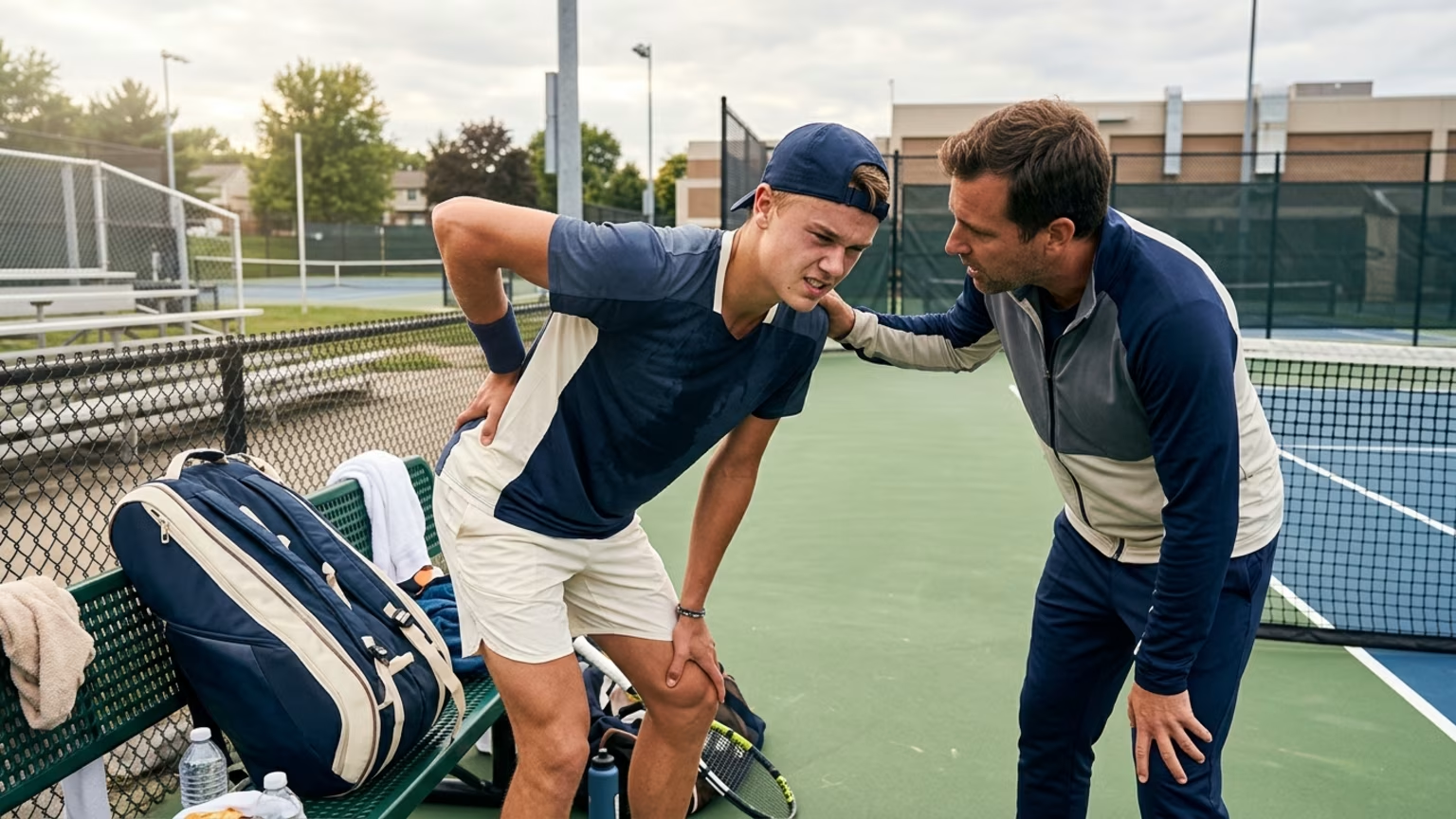
Holger Rune withdrew from the European Open with a back problem. The facts behind his decision and a grounded perspective for recreational players.

The Dink’s October 17 guide emphasizes deep returns, ball-height decisions and positioning against faster pickleball opponents.

A new report outlines padel and tennis gear trends. Learn how to assess adjustable rackets, sensor feedback and smart-court claims.
Read practical guidance for better movement, smarter preparation and a game that keeps working for you.
explore the Blog
