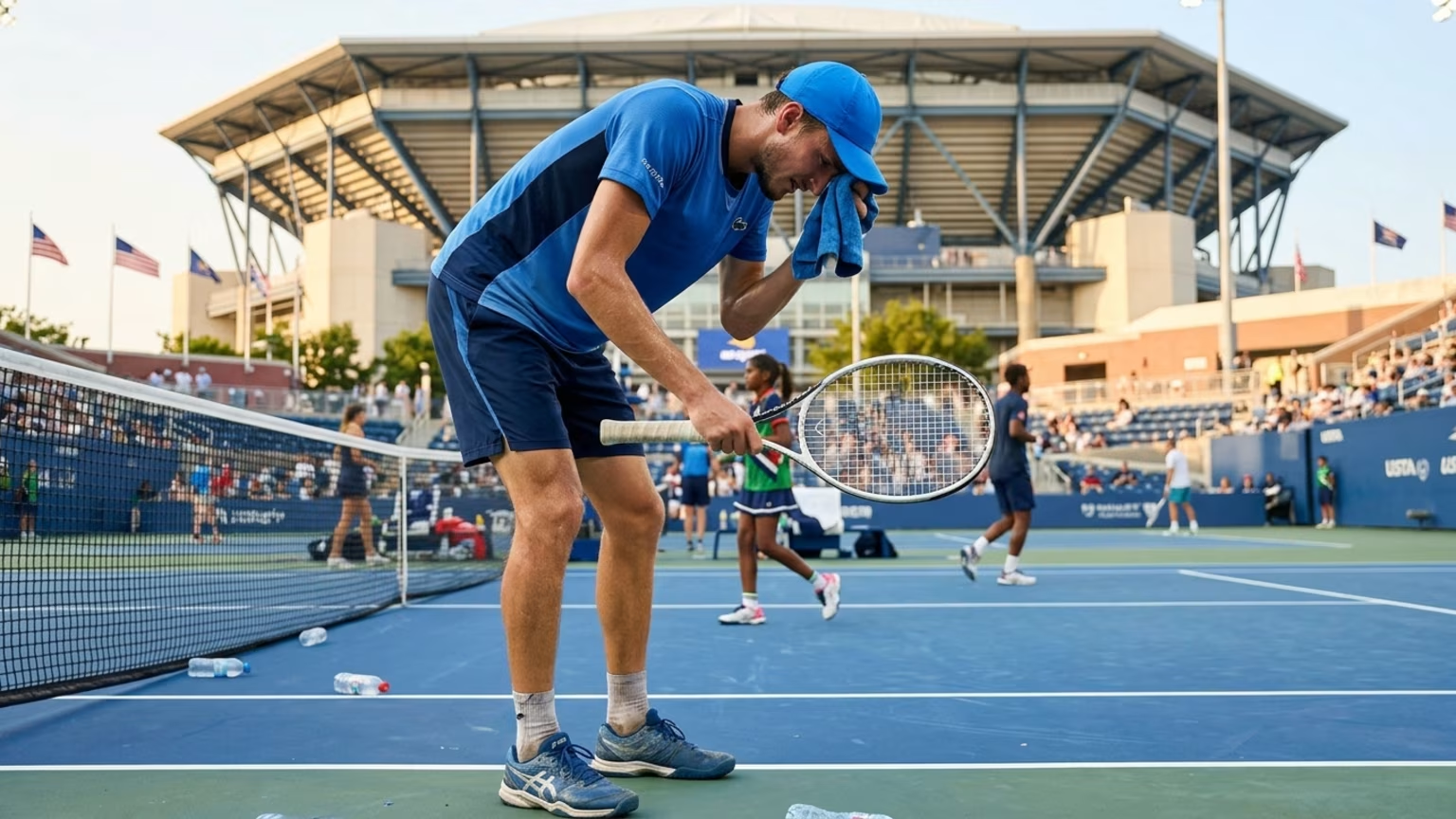

Match data from Medvedev vs. Rinderknech at the 2026 US Open highlights the importance of serve efficiency and point construction for healthy aging in tennis.




Daniil Medvedev defeated Arthur Rinderknech in the third round of the 2026 US Open on September 4, 2026. The two professional players competed on a hard court at the USTA Billie Jean King National Tennis Center in New York. This ATP men's singles match concluded quickly in straight sets. Medvedev secured his victory with a final score of six games to four across all three sets.
Medvedev entered the New York event as the seventh seed in the draw. Rinderknech arrived as the number 26 seed and the world number 29 player. The head to head record between the two competitors was tied at one match each before this tournament. Medvedev won their previous meeting at the 2022 US Open, while Rinderknech took their most recent match at the 2025 Shanghai Masters.
This latest victory marked the 35th win of the 2026 season for Medvedev. Both athletes are right handed professionals competing in their early thirties. Medvedev was listed at 30 years old with a birth date of February 11, 1996. Rinderknech was listed at 31 years old and was born on July 23, 1995.
The Yahoo Sports match page records Medvedev at 83 kilograms. The same match page lists Rinderknech slightly heavier at 86 kilograms. These physical profiles highlight two very experienced players navigating the physical demands of modern hard court tennis. The victory moved Medvedev into the fourth round for the seventh time in eight years.
He had won all three of his matches at the 2026 tournament in straight sets up to that point. Medvedev also won this entire tournament previously in 2021. This continued advancement shows that players in their early thirties can still compete successfully in best of five Grand Slam tennis. The result offers a useful case study in how first serve effectiveness and point construction interact at the elite level.
The US Open match report detailed a highly efficient serving start for both men. Both competitors won 100 percent of their first serve points through the first four games. Rinderknech did not even need to hit a second serve until his third service game of the match. However, his second serve points quickly became a noticeable vulnerability.
The official report noted that Rinderknech won only one of his next nine second serve points. This small match sample shows how a predictable second serve creates an immediate scoring target. Medvedev committed nine unforced errors early in the first six games. After that described turning point, he committed only four unforced errors during the remainder of the first set.
He finished the match with nine unforced errors over the entire final portion. Tennis Tonic reported the first set lasted 51 points in total. Medvedev won 28 of those points, while Rinderknech took 23 points. Medvedev conceded six points on his serve, and Rinderknech conceded eight points on his serve.
Another segment of the match statistics indicated Medvedev won only one more point than his opponent in the opening set with a 25 to 24 margin. The official match report credited Medvedev for combining strong baseline defense with a low error approach. He used a backboard style to force Rinderknech to play additional balls.
Elite professionals have specialized coaching and recovery support that most adult competitors lack. A single professional match cannot establish a universal rule about athletic longevity for older players. However, this match offers practical coaching guidance in point construction for athletes over thirty. Recreational players should use these statistics as a prompt to measure serve quality rather than just serve speed.
Adult athletes should track their first serve percentage and whether the serve produces a favorable first ball. We recommend practicing serve plus one patterns during regular training sessions. A strong serve directed to a defined location allows a player to anticipate the return and hit a controlled attacking shot.
In our experience, proper preparation is essential for maintaining athletic longevity. A solid routine helps players perform better and avoid unnecessary stiffness. One of our team members recently shared a relevant story about court preparation. "When I first started playing pickleball, I noticed how many people skipped warming up entirely."
"They would jump straight out of their cars and right up to the kitchen line. I tried doing that and immediately pulled a calf muscle. Pickleball requires just as much explosive lateral movement as tennis, just in a tighter space."
"Since then, I always spend five minutes doing dynamic lunges and ankle rolls. It changes everything about how confident I feel pushing off the baseline." Recreational tennis players can apply this disciplined approach to their own practice blocks. Older players should build second serve reliability into every session to avoid vulnerable stretches during matches.
Shorter training blocks focused on serving and first strike sequences provide high quality repetitions without excessive fatigue. Players must preserve their baseline competence rather than abandoning rally skills entirely. The US Open report emphasized that Medvedev maintained defensive coverage while keeping his errors low. Adult players should pair serving drills with return drills to improve placement and recovery positioning.
Players with shoulder or elbow limitations should seek qualified coaching advice before increasing their serving volume. Developing a balanced training program ensures players can sustain their performance throughout the competitive season. You can refine your own preparation by checking our guide to targeted practice and reduced court time for adult athletes. You must compare your practice performance directly with your match performance.
A serve that looks effective in a basket drill might produce weak second ball positions under real pressure. If a serve does not yield an advantage, it is not yet an efficient match serve. In pickleball and padel, first strike play may mean reaching a strong net position rather than just hitting harder. Applying these tactical lessons carefully will support better decision making on the court.
Finding the right balance between aggressive serving and consistent baseline defense helps manage physical energy. The remainder of the 2026 US Open will test how well veteran players manage their physical energy. We expect older professionals to rely increasingly on first serve efficiency as fatigue accumulates in later rounds. Efficient point construction will likely determine who advances deep into the tournament draw.
The ability to dictate play early in the rally remains crucial for athletes competing in their thirties. Watch closely to see how players adjust their second serves when facing aggressive returners. Future matches will continue to highlight the importance of error management under intense pressure. We will observe whether older competitors maintain their aggressive first strike tactics or rely on baseline rallies.
Defensive coverage is still necessary, but smart serving patterns significantly reduce the total physical toll on the body. Racquet sports players of all levels can learn from this careful balance of power and consistency. Developing a strong prematch routine will help competitors apply these professional lessons locally. You can also explore building a smarter season schedule to protect your body during competitive seasons. The best players understand that thoughtful preparation yields the best results.
Follow Evercourts for practical insights on tennis, pickleball and padel performance, movement, recovery and healthy ageing. Stay connected for new articles, research-led guidance and ideas to help you play well and keep playing for years.


Compare court size, singles and doubles formats, and wall rebounds to choose tennis, pickleball or padel around your preferences and schedule.
How anticipation informs movement in tennis, pickleball and padel, with research-backed distinctions and practical coaching cues for the next ball.
Holger Rune withdrew from the European Open with a back problem. The facts behind his decision and a grounded perspective for recreational players.
Read practical guidance for better movement, smarter preparation and a game that keeps working for you.
explore the Blog
