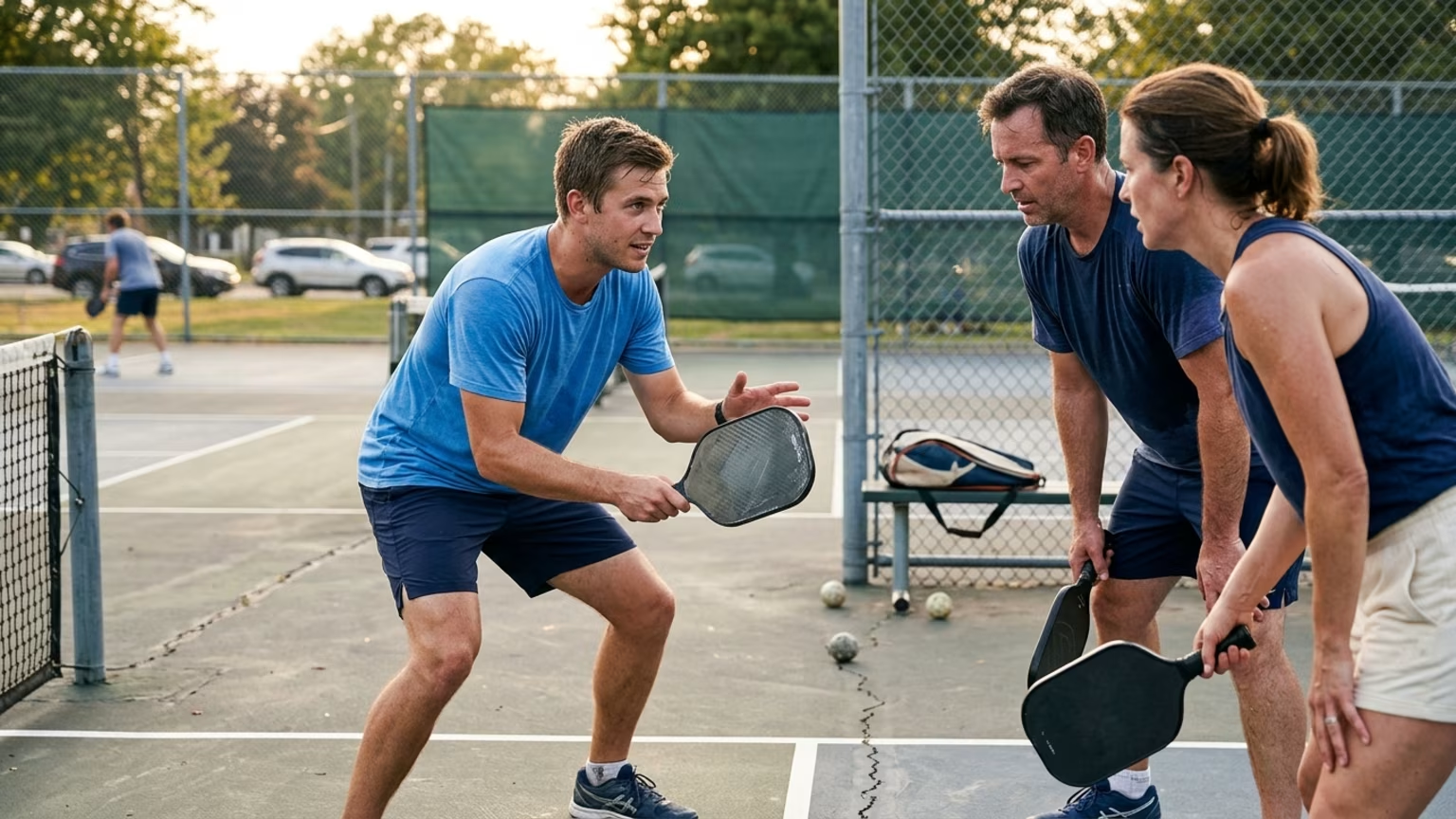

Review Zane Navratil’s 17-point framework for improving pickleball practice, strategy and decision-making to support long-term athletic performance.




On September 11, 2026, Pickleball.com published a comprehensive guide featuring 17 recommendations from teaching professional Zane Navratil. The article outlines practical methods for improving practice quality, competition strategy and on-court decision-making. Navratil focuses heavily on preparation, mindset and structured development for players seeking better performance. The release provides a clear framework for those who want to refine their skills systematically.
Navratil centers his philosophy on prioritizing quality over quantity during court time. He argues that lengthy sessions do not automatically produce improvement, and distracted repetitions often reinforce bad habits. His 17 points advise players to drill specific shots, warm up properly and seek advice suited to their exact skill level. He notably differentiates between match play and practice by stating that players should play games for competition and drill for development.
The Pickleball.com guide also covers in-game tactics and opponent selection. Navratil recommends hitting toward the stronger player to invite more challenging decisions. He suggests playing up against better opponents but warns against playing far above your current ability. The professional advises choosing just one priority to improve until it becomes automatic.
Navratil strongly advises players to choose just one priority and work on it until the movement becomes completely automatic. Amateurs frequently make the mistake of trying to correct their footwork, paddle position and court positioning all at once. This scattered focus often leads to cognitive overload and decreased overall match performance. Isolating a single technical element ensures that practice repetitions yield measurable improvement before moving to the next challenge.
For the adult recreational player, this framework shifts the focus away from random open play. Professional players drill relentlessly because crucial shots occur too infrequently in a standard game to master through match play alone. Navratil argues that targeted drilling provides the repeated practice necessary for these specific situations. Amateurs often incorrectly assume playing more matches will fix their technical flaws.
Recreational players frequently skip physical preparation entirely. When I first started playing pickleball, I noticed how many people ignored warming up. They would jump straight out of their cars and right up to the kitchen line. I tried doing that and immediately pulled a calf muscle.
Pickleball requires just as much explosive lateral movement as tennis, just in a tighter space. Since then, I always spend five minutes doing dynamic lunges and ankle rolls before playing. It changes everything about how confident I feel pushing off the baseline. Navratil echoes this necessity by including an on-court warm-up in his 17 recommendations.
Incorporating a proper dynamic warm-up routine prepares the body for sudden shifts in direction. Taking the time to properly establish timing helps you adjust to the opponent’s ball before competition begins. Proactive preparation supports overall readiness and helps players avoid early unforced errors. This simple routine protects athletic longevity across long tournament weekends.
Navratil frames video review as a critical tool for identifying poor habits that are difficult to detect during active play. He operates on the principle that players often do not realize what they are doing wrong in real time. Pickleball.com notes that self-analysis helps reveal technical patterns and positional errors. Recording selected games and reviewing them with one specific question in mind provides highly actionable feedback.
The guide presents hydration as directly relevant to energy, concentration, reaction time and decision-making during fast exchanges. Players are advised not to wait until they are exhausted or thirsty before drinking fluids. Navratil personally recommends adding electrolytes to maintain peak performance during demanding matches. Proper fluid management is a simple variable that every competitor can easily control.
Relying exclusively on random open play matchups can stall long-term development. Navratil recommends arranging games with players of a similar or slightly higher skill level to maximize the developmental value of court time. Massive skill gaps frequently result in short rallies that do not appropriately test either competitor. Finding partners who are willing to play purposefully ensures that practice matches generate enough complex rallies to stress-test your recent technical adjustments.
Tournament play serves as an excellent diagnostic tool within this coaching framework. Navratil explains that pressure and highly motivated opponents often expose hidden weaknesses. Casual open play rarely replicates the intensity required to test a player's true technical stability. Competing in structured events reveals exactly where your footwork or shot selection breaks down.
Another crucial component of the framework involves the psychological aspect of closing out matches. Navratil separates technical stroke development from actual competitive execution. He emphasizes the importance of learning to win, protecting leads and making sound decisions when securing victory is expected. Cultivating this mindset requires practicing under match-like pressure during weekly training sessions.
Pickleball.com cautions that coaching advice must match a player’s current skill level, goals and physical limitations. The guide specifically contrasts strategies suitable for an advanced professional with those appropriate for a developing amateur. Adopting professional tactics before mastering foundational mechanics often leads to frustration and unforced errors. Seeking feedback that addresses your immediate developmental stage ensures much more sustainable progress.
One of the most practical tips for amateur players is learning to ask why each point ended. Navratil treats every single rally as a valuable feedback opportunity. Connecting post-point reflection with better shot selection helps build sharper court anticipation over time. Instead of simply reacting to a lost point with frustration, players should objectively evaluate their court decisions.
The need for structured practice aligns precisely with the current state of the sport. According to mid-year data from the Sports & Fitness Industry Association, pickleball participation growth moderated to 1.3 percent in the first half of 2026. After five consecutive years as the fastest-growing sport in the country, this moderation suggests a maturing player base. Participants are likely transitioning from casual trial phases to seeking formal improvement strategies.
A structured pickleball training model provides the exact foundation these developing players need. Over the next season, expect recreational facilities to allocate more dedicated time for formal drilling rather than just open play. Players will increasingly treat their court time as planned development blocks rather than pure recreation. Video review and targeted coaching will soon become standard tools for amateurs looking to refine their court movement and footwork habits.
Follow Evercourts for practical insights on tennis, pickleball and padel performance, movement, recovery and healthy ageing. Stay connected for new articles, research-led guidance and ideas to help you play well and keep playing for years.


An evidence check on sports supplements like tart cherry juice. Learn why racquet sports players should prioritize core nutrition over functional foods.
In late 2026, Oura analyzed wearable data to see how recreational tennis impacts heart health and recovery. Learn what this means for your athletic longevity.
Recent guidelines emphasize gradual progression, dynamic warm-ups, and scheduled recovery to help adult racquet sports players maintain athletic longevity.
Read practical guidance for better movement, smarter preparation and a game that keeps working for you.
explore the Blog
