
India's 41-medal run at the 2026 Pickleball World Cup highlights expanding competitive pathways for senior athletes. Learn what this means for your match play.




On September 9 of 2026, news outlet ANI reported that India finished fourth among 82 nations at the Pickleball World Cup in Vietnam. The event ran from August 30 through September 6 in the city of Da Nang. Regional coverage described the tournament as Asia's first Pickleball World Cup. This performance marks a notable shift in international standings and age-group representation.
The Indian delegation arrived in Vietnam with 48 athletes. The competitors entered several divisions including Kids, Juniors, Open, Seniors and Masters. According to ANI, India won 41 medals. This total included seven golds, 17 silvers and 17 bronzes.
The 2026 performance improved significantly on India's seventh-place finish at the previous World Cup in 2025. During that debut year, the delegation brought home 25 medals. The rapid year-over-year growth points to a much more organized national pipeline. It is worth noting that international scoring methodologies can sometimes vary.
An independent event-results site listed India with 35 named individual medallists and a different third-place ranking. That specific site excluded a silver medal won by India's Kids team from its individual count. Regardless of the exact tally, the delegation demonstrated broad depth across multiple generations. Success was clearly not limited to the open division.
Adult competitors secured numerous critical podium finishes. Fayrouz Zaidi won gold in the 40-plus women's singles category. Siddharth Reddy and Zaidi also won silver in the 40-plus mixed doubles event. In the older brackets, Shakuntala Devnani secured a bronze medal in the 60-plus women's singles category.
Bhushan Akut completed an impressive run by winning three gold medals. His victories included a reported 60-plus mixed-doubles title alongside Elizabeth Wilcox. The youth pathway contributed heavily to the overall results as well. Purvansh Patel won gold in the under-18 boys' singles event.
Veer Shah took bronze in the under-14 boys' singles division. India's Kids team also brought home a silver medal. This cross-generational participation indicates a rapidly maturing competitive structure. It successfully supports athletes from childhood well into their senior years.
Elite pickleball remains fiercely difficult at the very top. India's Open team experienced this reality firsthand during the tournament. They lost to the United States in the quarterfinals. This result highlights the intense demands of the highest professional tier.
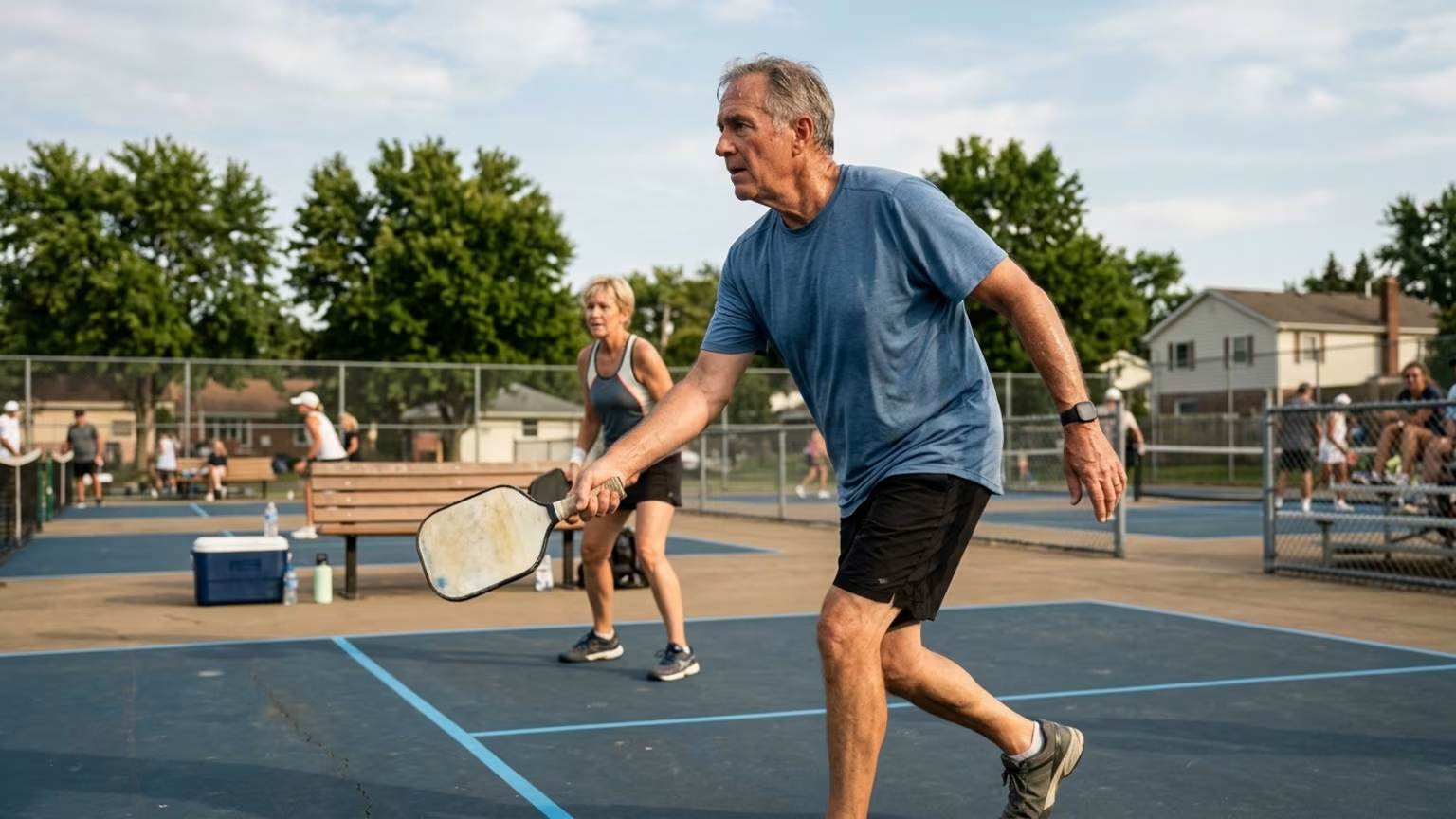
However, India's Masters team also reached the quarterfinals in their respective bracket. This proves that competitive opportunities remain highly relevant outside the open divisions. For the adult recreational player, this development is highly encouraging. It demonstrates that age-bracketed competition is a legitimate and respected tier of play.
Weekend league participants often feel pressured to play against much younger opponents. They may assume that the open division is the only true test of skill. The World Cup results validate a much different approach for older athletes. Players returning from an extended break can find tremendous value in age-appropriate brackets.
You do not need to play open division matches to experience intense, high-quality competition. A sustainable competitive plan must account for current movement capacity and match endurance. Competing in a 50-plus or 60-plus category simply means the physical baseline is adjusted for the competitors. This allows older adults to focus heavily on strategy, court positioning and tactical execution.
When I first started playing pickleball, I noticed how many people skipped warming up entirely. They would jump straight out of their cars and right up to the kitchen line. I tried doing that and immediately pulled a calf muscle.
Pickleball requires just as much explosive lateral movement as tennis, just in a tighter space. Since then, I always spend five minutes doing dynamic lunges and ankle rolls. It changes everything about how confident I feel pushing off the baseline.
Entering an appropriate division helps manage these exact physical demands. A senior tournament draw still requires exceptional skill, court awareness and conditioning. Developing a routine for protecting the core during aggressive swings remains vital for executing advanced tactics. Moving to an age-bracketed event is a highly practical strategy for athletic longevity.
The expansion of senior formats mirrors recent findings in sports science. A large observational analysis summarized by a health publication highlighted strong associations between racquet sports and healthy aging. The analysis associated racquet-sport participation with a 47 percent lower risk of death from any cause. The same data associated playing racquet sports with a 56 percent lower cardiovascular death risk compared to nonparticipation.
Additionally, a separate Danish study estimated a 9.7-year longer life expectancy for tennis players compared to a sedentary lifestyle. It is important to view these observational findings as encouragement rather than guaranteed outcomes. Pickleball provides excellent cardiovascular benefits, but players must pair court time with proper physical maintenance. Focusing on building foundational muscle capacity supports this long-term participation.
Older athletes face specific physical vulnerabilities that require dedicated attention. A 2026 bibliometric review of pickleball research described two major areas of academic focus. The first theme covers health promotion, well-being and social capital. The second theme focuses on injury risk among older adults, specifically noting concerns regarding fractures, sprains and falls.
Managing these risks requires a proactive approach to body maintenance. Age-group competition reduces the absolute speed of the game, but it does not eliminate the need for mobility work. Consistently monitoring court hours and intensity is critical for preventing the injuries that sideline older athletes. Focusing on optimizing overnight recovery between tournament days helps maintain reaction times and joint stability.
The scope of the World Cup highlights the massive global interest in the sport. Contemporary coverage indicated that approximately 4,000 people from 80 countries and territories were expected to attend. Separately, Vietnam's state news agency reported approximately 5,000 athletes for the event. While event participant counts vary, the scale of the gathering is completely undeniable.
Over the upcoming season, we expect regional leagues to lean heavily into graduated competition models. The success of international age-group brackets provides a clear blueprint for local tournament directors. We will likely see a wider adoption of local events that prioritize distinct age and rating classifications. This shift will give recreational players a much clearer runway for their competitive ambitions.
Clubs have a distinct opportunity to build events that serve players in their forties, fifties and sixties. By structuring tournaments around these demographics, organizers can keep older adults engaged in the sport safely. The focus will naturally shift from simply finding open court time to preparing for specific, age-appropriate events. As these pathways mature, players can confidently plan their tournament schedules for years to come.
Follow Evercourts for practical insights on tennis, pickleball and padel performance, movement, recovery and healthy ageing. Stay connected for new articles, research-led guidance and ideas to help you play well and keep playing for years.


Compare racquet, paddle and court-shoe upgrades by fit, feel, surface and budget, with practical demo checks and a clear buying priority.

Understand calf and ankle demands in racquet sports, what injury research shows, and how gradual preparation can be scaled to current ability.

Understand padel’s movement demands and how practitioner guidance frames strength, balance and controlled direction changes alongside cardio.
Read practical guidance for better movement, smarter preparation and a game that keeps working for you.
explore the Blog
