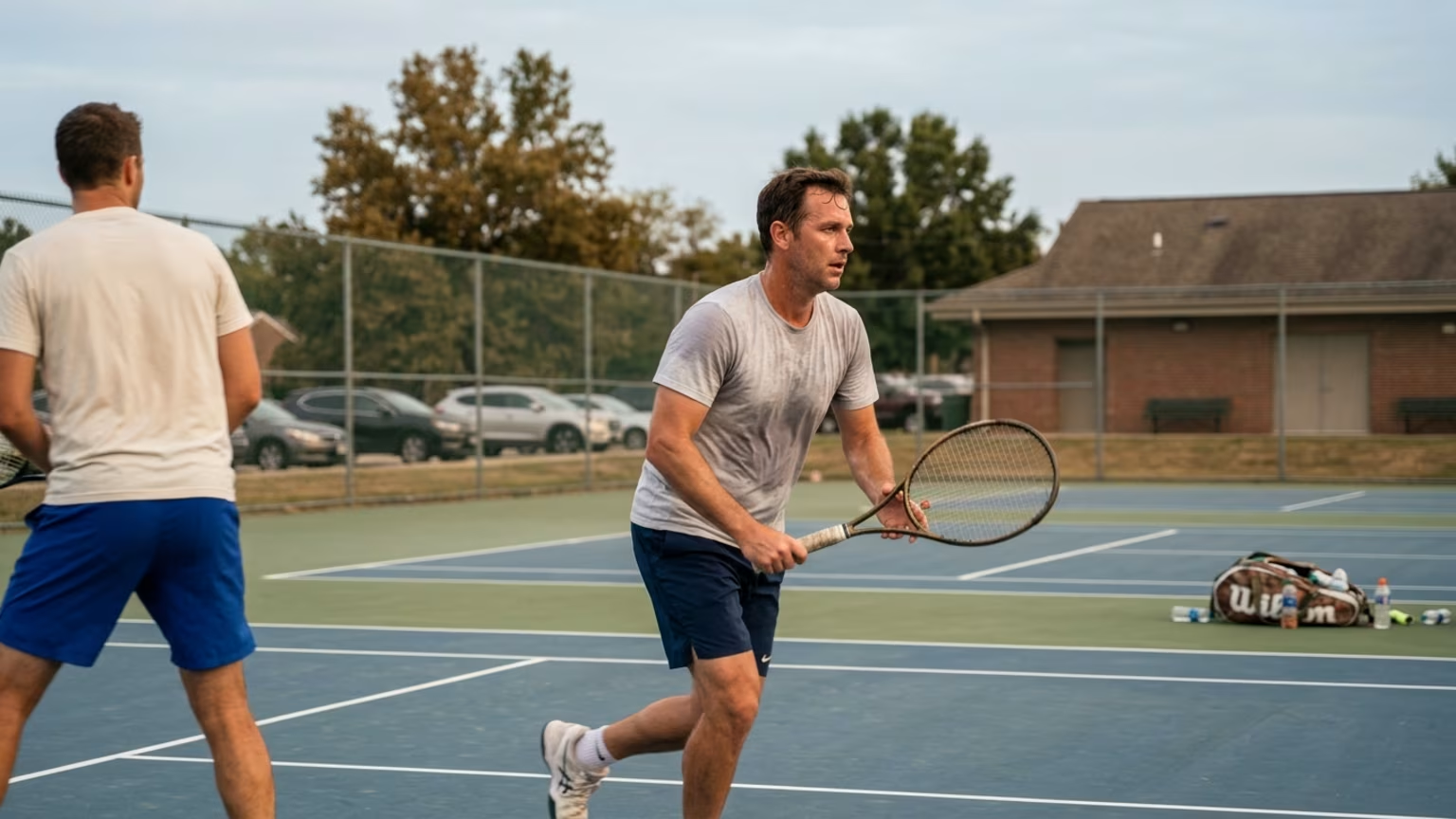

Alexander Zverev and Ben Shelton faced rapid turnarounds from the 2026 US Open final to Davis Cup ties. Learn how adult players can manage tournament schedules.




On Sunday, September 13, Alexander Zverev defeated Ben Shelton in four sets to win the 2026 US Open men's singles final. Instead of taking an extended rest period to recover from a gruelling two-week tournament, both finalists immediately transitioned to representing their countries in Davis Cup qualifying later that same week. This highly compressed schedule required rapid intercontinental travel from New York back to European venues for both players. The swift transition from a major individual final to immediate national team competition highlights the ongoing tension between individual athlete recovery and collective team obligations.
Zverev secured his second Grand Slam title with a 6-3, 7-6, 5-7, 6-2 victory in New York. Days after finishing the final match of the US Open, he traveled to Halle for Germany's September 19 and 20 Davis Cup tie against Croatia. The German team roster included Zverev, Yannick Hanfmann, Tim Pütz and Kevin Krawietz. They faced a Croatian squad featuring Marin Čilić, Dino Prizmić, Mate Pavić and Nikola Mektić.
These qualifying ties carried significant weight because teams were directly competing for places in the November Davis Cup Finals in Bologna. The team format creates collective pressure, as an individual player's availability can materially alter a country's prospects of advancing. Germany captain Michael Kohlmann welcomed Zverev's decision to join the squad. Kohlmann called the participation a strong signal following the player's physically demanding Grand Slam season.
Contemporary reporting described Zverev's participation as a choice made despite internal reservations. This suggests that the decision involved more than simple tournament scheduling. While his decision to play was praised by team officials, that does not establish that playing immediately was optimal for his long-term career management. The event serves as a useful case study in scheduling pressure.
Shelton navigated a similarly tight schedule following his runner-up finish. He traveled from New York to Prague for the United States' Davis Cup tie against the Czech Republic. The American team's tie was scheduled for September 18 and 19. This timeline required Shelton to return to competitive play less than a week after competing in the US Open final.
Following these national duties, Shelton withdrew from the upcoming Laver Cup. Brandon Nakashima was announced as his replacement for that subsequent team event. Reports did not give a specific reason for Shelton's withdrawal. However, the timing placed it immediately after his US Open final and Davis Cup commitment.
Recreational players frequently face their own version of calendar congestion. A heavy weekend tournament often bleeds directly into a Tuesday night league match. When professionals make rapid transitions between venues, they rely on support teams, medical staff and highly specialized travel resources. Adult amateur players must manage their own recovery alongside daily work and family commitments.
We should view a tournament transition as a recovery problem first and a performance problem second. Recreational players should not treat these professional timelines as a medical guarantee or a validated protocol. When amateur players try to push through similar scheduling bottlenecks, they often compromise their joint health. Reducing match density is a crucial skill for athletic longevity.
Players often underestimate how travel and emotional stress compound physical fatigue. Even a short drive home from a weekend event can disrupt sleep patterns and delay the body's natural healing process. For adult competitors balancing racquet sports with busy lives, managing demanding match schedules requires intentional calendar management. Learning how to cover the court better reduces physical toll, but it cannot replace actual rest.
I used to think a tough conditioning block was the only way to improve my court endurance during a busy competition month. Then I started tracking my sleep after away fixtures. I noticed that on days I slept less than six hours after traveling, my reaction time at the net was noticeably sluggish, and I felt gassed by the second set. Prioritizing consistent rest did more for my late match stamina than any extra sprints ever did.
When moving between venues, players must also account for different playing environments. The available event coverage identifies Halle as an indoor hard court setting for the German tie. Even when transitioning between familiar hard courts, the body needs time to adapt to different traction, lighting and bounce dynamics. Travel, disrupted sleep and accumulated match load all change how your joints handle the impact of a familiar surface.
Adult competitors should reintroduce the next court environment progressively. Begin with timing, footwork and controlled hitting before adding high-intensity serving or repeated sprints. Making your first session back a full competitive match increases your risk of physical setbacks. Monitor your body for warning signs of strain rather than relying solely on motivation.
Do not assume that a familiar surface means the body is fully recovered. Even when consecutive events use hard courts, the physical toll of a recent tournament remains a primary factor. A rapid turnaround demands a specific focus on recovery routines rather than pushing for immediate performance gains. Adult players managing tennis, pickleball or padel must respect these physical limits.
Reducing match density is often the most realistic approach for amateur players. We cannot simply copy professional schedules without access to professional recovery resources. A player who reaches a weekend final requires a different recovery plan than someone eliminated in the opening round. Build a buffer into your league and tournament calendars whenever possible.
Taking an extra rest day protects your joint health and ensures better performance when you finally return to the court. This conservative approach helps players keep improving their game without breaking down.
The narrow window between the US Open and Davis Cup qualifying will likely continue forcing difficult choices for top players. The Davis Cup format adds collective pressure because an individual player's availability can materially affect a country's prospects of reaching the Finals. Shelton's decision to play Davis Cup but skip the Laver Cup demonstrates that players may distinguish between different team events. Participating in one team event does not automatically mean participation in another event the following week.
As the international calendar remains crowded, we expect to see more players selectively skipping secondary events to protect their physical capabilities. Workload management is becoming just as tactical as on-court strategy. Adult players should take note and apply the same calendar restraint to their upcoming seasons. Strategic scheduling allows players to maintain their physical capabilities and continue playing for years to come. By treating recovery as a non-negotiable part of the season, players can safely navigate their own busy tournament schedules.
Follow Evercourts for practical insights on tennis, pickleball and padel performance, movement, recovery and healthy ageing. Stay connected for new articles, research-led guidance and ideas to help you play well and keep playing for years.


A recent live-play test of a silent pickleball highlights its value for practice, but standard balls still perform better for match play and power control.

An evidence check on sports supplements like tart cherry juice. Learn why racquet sports players should prioritize core nutrition over functional foods.
In late 2026, Oura analyzed wearable data to see how recreational tennis impacts heart health and recovery. Learn what this means for your athletic longevity.
Read practical guidance for better movement, smarter preparation and a game that keeps working for you.
explore the Blog
