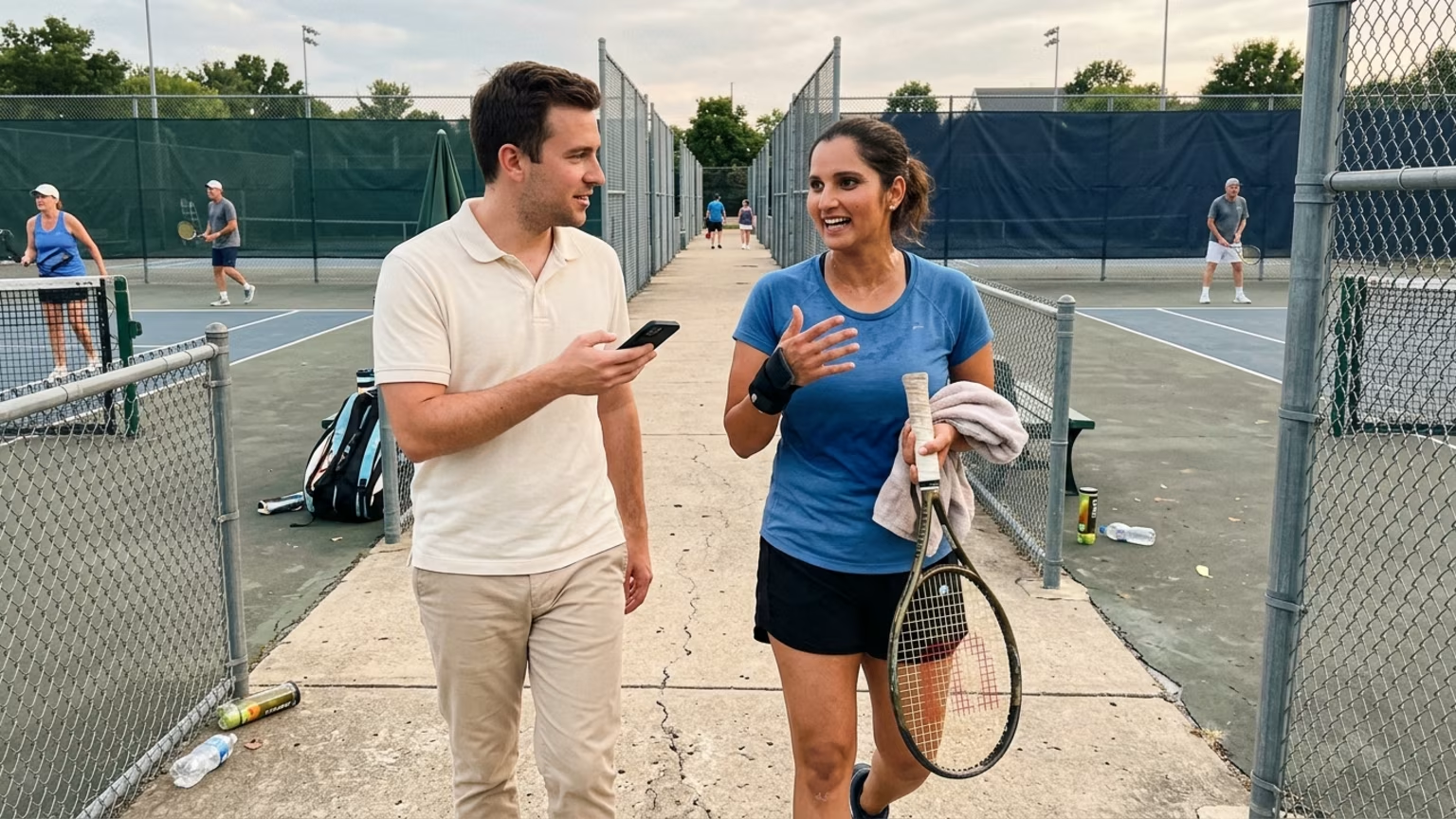

Sania Mirza's insights on Carlos Alcaraz's 114-day wrist injury absence reveal why proper recovery requires active rebuilding, not just time off the court.




You have heard it a million times: rest heals all injuries, and complete time away is all you need to return to form. Here is why that is outdated. The reality is that returning from time off requires progressively rebuilding timing, confidence, and match conditioning alongside physical healing. After going 114 days without playing a competitive match, Carlos Alcaraz stepped back onto the court at the US Open.
That roughly four-month absence illustrates exactly how a single physical interruption can rewrite a competitive calendar. Former elite player Sania Mirza highlighted this exact tension perfectly in a recent Mid-Day interview. She correctly noted that injuries require comprehensive management, not just a passive break from competition.
This misconception starts with a fundamental misunderstanding of tissue recovery. Recreational athletes often assume that a lack of pain equals complete competitive readiness. When a joint stops aching, players naturally want to immediately resume their normal league matches and tournament weekends. It is an understandable instinct for adult racquet sports players who simply want to stay active, socialize, and compete.
The culture of modern sports also glorifies pushing through discomfort. Many players believe that modifying a schedule shows weakness or a lack of commitment. Mirza offered a more pragmatic view when discussing Alcaraz, noting that wrist injuries are not easy to come back from. She clearly understood that resting a joint is only the first stage of a proper rehabilitation process.
A pain-free wrist might tolerate daily life perfectly well while still failing under the extreme stress of repeated racquet acceleration. If you take three weeks off for a sore arm and immediately play a three-hour match, your tissues are entirely unprepared for that sudden spike in workload. Returning too quickly without proper conditioning often creates a frustrating, predictable cycle of recurring aches. Understanding why equipment changes cannot fix persistent tennis arm pain is a related concept, as players often search for quick external fixes instead of addressing tissue capacity.
The biomechanical gap between basic health and match readiness is massive. Alcaraz missed roughly four to five months of competition because of his right wrist injury. BBC and The Athletic described the specific issue as tenosynovitis, which involves inflammation around a tendon sheath in the wrist. This persistent problem forced him to withdraw from the Barcelona Open before missing the French Open, Wimbledon, Toronto, and Cincinnati.
During an extended break, a player loses the specific physical resilience built through regular, high-intensity match play. Reuters reported that Alcaraz's uncertainty about his return even contributed to intrusive thoughts during his layoff. When a player finally steps back onto the court, they face the difficult challenge of trusting their body again. This is particularly true across different racquet sports, as each discipline stresses the arm differently.
Tennis demands massive shoulder rotation and high racquet head speed for topspin. Pickleball creates repetitive, jarring impacts near the kitchen line, requiring rapid wrist stability. Padel involves heavy slicing, aggressive overheads, and frequent off-center hits against the glass. Rebuilding tolerance to these specific, varied impacts takes strategic patience.
Alcaraz won his opening match against Roman Safiullin in straight sets, hitting more than 20 forehand winners. While that victory demonstrates competitive readiness for one specific match, it does not instantly guarantee permanent clearance for a dense, challenging season. Mirza also discussed Novak Djokovic during her interview, pointing to the veteran player as a model of athletic longevity. She attributed the 39-year-old's continued success to a combination of hunger, physical fitness, determination, and natural ability.
Mid-Day identified Djokovic as a 24-time Grand Slam winner, which highlights the incredible durability required to stay at the top. Motivation alone is never enough to sustain a long career in tennis, pickleball, or padel. Players need durable joints, excellent cardiovascular fitness, and careful load management to stay on the court year after year without breaking down.
Adult club players can apply these exact lessons to their own playing schedules. The first critical step is to count your total physical load rather than just tracking matches played. A week that includes two social games, a heavy serving practice, and a league match represents a significant amount of stress. You must balance high intensity matches with modified court sessions to avoid sudden spikes in workload.
Next, prioritize a highly gradual return if you take time off for any physical issue. Alcaraz originally planned to use Cincinnati as a return event, but he ultimately withdrew to continue his recovery. This highlights a crucial strategy for all players: the most obvious upcoming competition is not always the best choice for a comeback. Start with easy hitting, progress to controlled point play, and finally introduce full competitive matches.
Adapting your movement to shorter formats can also help manage early fatigue as you regain your rhythm. A sustainable racquet sports program requires dedicated physical conditioning off the court. Wrist pain requires serious attention, but players also need strong calves, durable hamstrings, and capable shoulders to support long-term play. The professional schedule shows how fast things change, as Jannik Sinner also withdrew from the US Open due to a right knee injury.
You cannot always predict an injury, but sensible scheduling improves your baseline physical resilience. Marca listed several events on Alcaraz's projected schedule. These included the US Open, Laver Cup, and Tokyo. He was also projected to play in Shanghai, Paris, and the ATP Finals. A packed calendar demands planned recovery.
Mirza’s praise of Djokovic’s hunger is valuable, but recreational players should clearly distinguish healthy motivation from harmful urgency. Wanting to compete is a fantastic trait, but feeling obligated to play every available match despite pain is a different issue entirely. A practical question to ask yourself before committing to another event is simple: can you recover from this session and still perform your essential daily responsibilities? If the answer is no, reducing your volume may protect your ability to keep playing later in the season. Strategic match scheduling is a fundamental skill for athletic longevity.
The ultimate goal of this careful management is healthy aging and consistent participation. A summary of a British cohort study involving 80,306 adults reported an association between racquet sports and a 47% lower risk of all-cause mortality. The same summary noted a 56% lower risk of cardiovascular death for participants. A separate summary of Copenhagen City Heart Study findings estimated a 9.7-year life expectancy difference for tennis players compared to sedentary people.
A large US analysis involving 272,550 older adults also showed a 16% lower risk of all-cause death, alongside a 27% lower risk of cardiovascular death. These are observational associations, not guaranteed promises, but they underline why maintaining your health is so vital. Keeping your body prepared through smart workload management ensures you can reap these long-term benefits. Cross training effectively supports this ongoing physical durability.
The New Golden Rule: Recovery is an active process of rebuilding tolerance, not just a passive break from competition. Thinking back to Alcaraz going 114 days without a competitive match, the most impressive part of his return was not the flashy forehand winners. The true achievement was executing a structured, patient comeback despite massive external pressure to play earlier. Treating your own time off with that same calculated patience will keep you active, competitive, and enjoying the court for years to come.
Follow Evercourts for practical insights on tennis, pickleball and padel performance, movement, recovery and healthy ageing. Stay connected for new articles, research-led guidance and ideas to help you play well and keep playing for years.


Holger Rune withdrew from the European Open with a back problem. The facts behind his decision and a grounded perspective for recreational players.

The Dink’s October 17 guide emphasizes deep returns, ball-height decisions and positioning against faster pickleball opponents.

A new report outlines padel and tennis gear trends. Learn how to assess adjustable rackets, sensor feedback and smart-court claims.
Read practical guidance for better movement, smarter preparation and a game that keeps working for you.
explore the Blog
